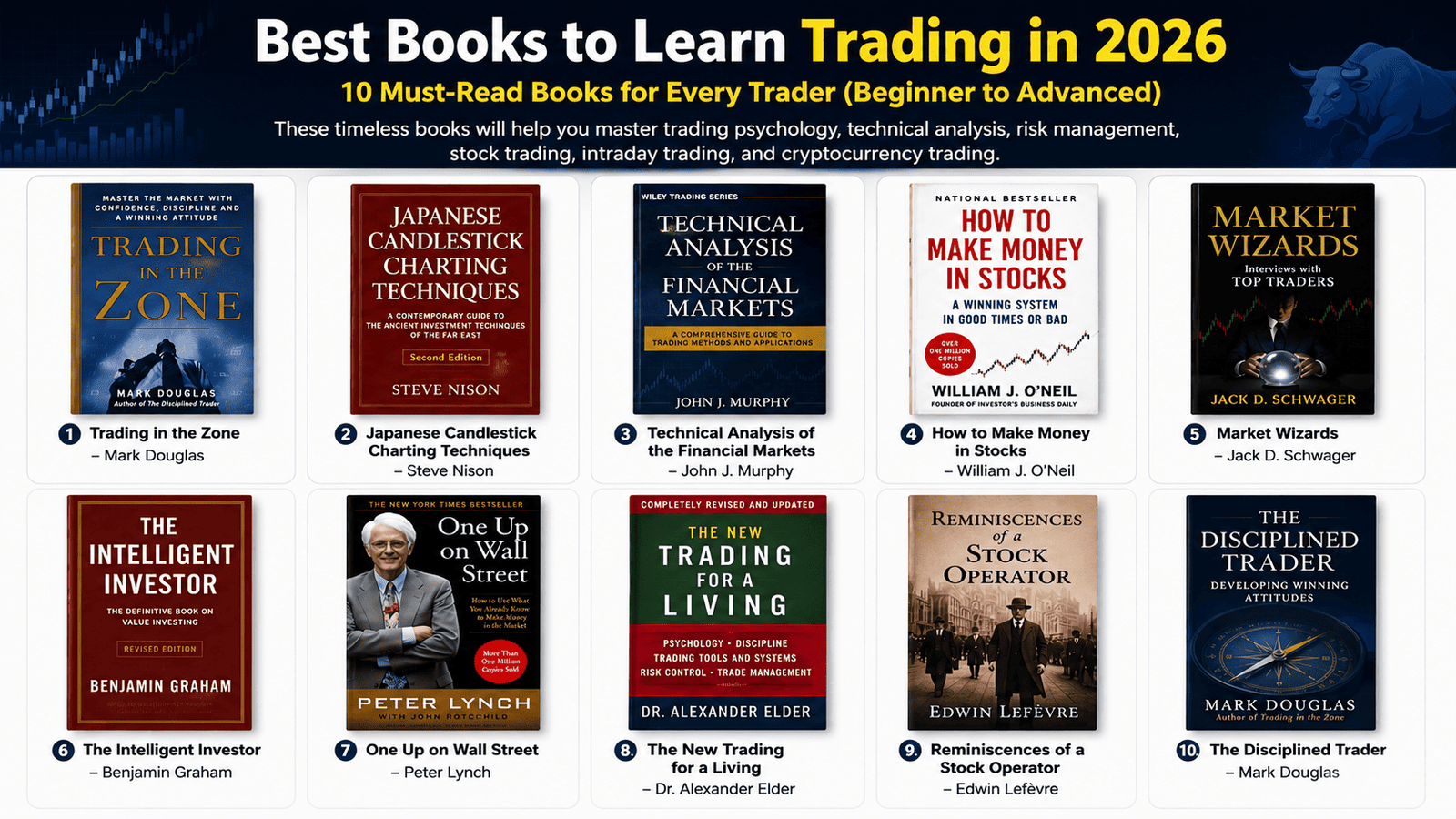
Whether you're just starting your trading journey or looking to improve your market performance, reading the right trading books can save you years of costly mistakes. While online courses and YouTube videos are popular, many of the world's most successful traders still recommend learning from books written by experienced investors, psychologists, and market experts.
The best books to learn trading cover essential topics such as technical analysis, market psychology, risk management, price action, stock selection, and trading discipline. These timeless lessons help traders understand how markets work and develop strategies that can be applied across stocks, forex, commodities, and cryptocurrencies.
In this guide, you'll discover the best books to learn stock trading, intraday trading, swing trading, and cryptocurrency trading. Whether you trade in India or global markets, these books provide valuable insights for every experience level.
Why Should Every Trader Read Trading Books?
Financial markets change constantly, but human psychology remains the same. Fear, greed, patience, and discipline influence trading decisions today just as they did decades ago. That's why classic trading books remain relevant even in 2026.
Reading trading books helps you:
-
Understand how financial markets operate
-
Learn proven trading strategies
-
Improve risk management skills
-
Develop emotional discipline
-
Avoid common beginner mistakes
-
Build confidence before trading with real money
Books also provide structured learning that is often missing from short online videos and social media content.
How to Choose the Right Trading Book
Not every trading book is suitable for every trader. Before buying a book, consider your current knowledge and trading goals.
Experience Level Recommended Topics| Beginner | Stock market basics, trading psychology, candlestick charts |
| Intermediate | Technical analysis, swing trading, price action |
| Advanced | Risk management, portfolio management, quantitative trading |
If you're interested in intraday trading, focus on books covering chart patterns, momentum trading, and risk management. Investors should prioritize books on company analysis and long-term wealth creation.
Quick Comparison of the Best Trading Books
Book Best For Difficulty Rating| Trading in the Zone | Psychology | Beginner | ⭐⭐⭐⭐⭐ |
| Japanese Candlestick Charting Techniques | Technical Analysis | Beginner | ⭐⭐⭐⭐⭐ |
| Technical Analysis of the Financial Markets | Chart Analysis | Intermediate | ⭐⭐⭐⭐⭐ |
| How to Make Money in Stocks | Swing Trading | Intermediate | ⭐⭐⭐⭐⭐ |
| Market Wizards | Professional Insights | Beginner | ⭐⭐⭐⭐⭐ |
| The Intelligent Investor | Long-term Investing | Intermediate | ⭐⭐⭐⭐⭐ |
| One Up on Wall Street | Stock Picking | Beginner | ⭐⭐⭐⭐⭐ |
| The New Trading for a Living | Complete Trading | Intermediate | ⭐⭐⭐⭐⭐ |
| Reminiscences of a Stock Operator | Market Psychology | Beginner | ⭐⭐⭐⭐⭐ |
| The Disciplined Trader | Trading Mindset | Intermediate | ⭐⭐⭐⭐☆ |
1. Trading in the Zone – Mark Douglas
Best For: Trading Psychology
This book is widely regarded as one of the most important books ever written for traders. Instead of teaching indicators or chart patterns, Mark Douglas focuses on the psychological challenges that prevent traders from becoming consistently profitable.
Many traders know how to identify good setups but still lose money because of emotional decisions. Fear of losing, greed after winning trades, hesitation, and overconfidence often lead to poor execution.
Douglas explains why successful trading requires thinking in probabilities rather than trying to predict every market move. His lessons help traders become more disciplined and emotionally stable.
Key Lessons
-
Accept uncertainty in every trade.
-
Focus on long-term consistency instead of individual trades.
-
Develop confidence in your trading system.
-
Eliminate emotional decision-making.
Best for: Day traders, swing traders, forex traders, and cryptocurrency traders.
Rating: ⭐⭐⭐⭐⭐
2. Japanese Candlestick Charting Techniques – Steve Nison
Best For: Technical Analysis
Steve Nison introduced Japanese candlestick charts to Western traders, making this one of the most influential trading books ever published.
Candlestick charts reveal market sentiment and help traders identify potential reversals, continuations, and breakout opportunities. The book explains how to recognize popular patterns and combine them with support, resistance, and trend analysis.
Popular patterns covered include:
-
Hammer
-
Doji
-
Bullish Engulfing
-
Bearish Engulfing
-
Morning Star
-
Evening Star
-
Shooting Star
-
Hanging Man
Instead of relying on indicators alone, traders learn how price itself provides valuable information about buyer and seller behavior.
Ideal For
-
Intraday traders
-
Swing traders
-
Options traders
-
Stock market beginners
Rating: ⭐⭐⭐⭐⭐
3. Technical Analysis of the Financial Markets – John J. Murphy
Best For: Comprehensive Technical Analysis
Often called the "Bible of Technical Analysis," this book provides a complete understanding of chart reading and market behavior.
John Murphy explains every major technical concept in simple language, making it suitable for traders who want to build a strong analytical foundation.
Topics covered include:
-
Dow Theory
-
Market Trends
-
Support and Resistance
-
Moving Averages
-
RSI
-
MACD
-
Bollinger Bands
-
Volume Analysis
-
Intermarket Analysis
Unlike many books that focus on one strategy, Murphy teaches how different indicators work together to improve trading decisions.
This book is especially useful for traders who want to move beyond basic candlestick analysis.
Best For
-
Stock traders
-
Forex traders
-
Futures traders
-
Commodity traders
Rating: ⭐⭐⭐⭐⭐
4.How to Make Money in Stocks – William J. O'Neil
Best For: Swing Trading and Growth Investing
William O'Neil developed the famous CAN SLIM investing strategy after studying thousands of successful stocks.
The book teaches readers how to identify high-growth companies before they become market leaders. Rather than buying cheap stocks, O'Neil emphasizes purchasing fundamentally strong companies with increasing earnings and strong price momentum.
The CAN SLIM strategy focuses on:
-
Current earnings growth
-
Annual earnings growth
-
New products or services
-
Supply and demand
-
Market leadership
-
Institutional buying
-
Overall market direction
Many successful investors continue to use these principles today.
Recommended For
-
Swing traders
-
Position traders
-
Long-term investors
Rating: ⭐⭐⭐⭐⭐
5. Market Wizards – Jack D. Schwager
Unlike traditional trading books, Market Wizards is a collection of interviews with some of the world's most successful traders.
Each trader follows a different strategy, proving there is no single formula for success. Some rely on technical analysis, others on fundamentals, while many combine both approaches.
Common lessons shared by nearly every trader include:
-
Protect your capital first.
-
Cut losses quickly.
-
Let profitable trades run.
-
Stay disciplined during losing streaks.
-
Never stop learning.
Reading the experiences of legendary traders helps beginners understand that consistent profitability comes from discipline, patience, and risk management—not from finding a "perfect" indicator.
Best For
-
Every trader, regardless of experience.
Rating: ⭐⭐⭐⭐⭐
6. The Intelligent Investor – Benjamin Graham
Best For: Long-Term Investing and Value Investing
When discussing the best books to learn stock trading and investing, The Intelligent Investor is always at the top of the list. Written by Benjamin Graham, the mentor of Warren Buffett, this classic book introduces the concept of value investing—buying quality companies at prices below their intrinsic value.
Although the book primarily focuses on investing rather than short-term trading, its principles help traders understand market behavior and avoid emotional decision-making.
One of the most famous concepts introduced is "Mr. Market," an imaginary business partner who offers different prices every day. Graham explains that successful investors should use market volatility to their advantage rather than reacting emotionally to price fluctuations.
Key Lessons
-
Invest with a margin of safety.
-
Ignore short-term market noise.
-
Focus on company fundamentals.
-
Think long term instead of chasing quick profits.
-
Control emotions during market volatility.
Pros
-
Timeless investing principles
-
Excellent for beginners
-
Improves financial decision-making
-
Recommended by Warren Buffett
Cons
-
Less suitable for active intraday traders
-
Some examples are dated
Best For
-
Stock investors
-
Swing traders
-
Beginners building long-term wealth
Rating: ⭐⭐⭐⭐⭐
7. One Up on Wall Street – Peter Lynch
Best For: Finding Winning Stocks
Peter Lynch managed one of the world's best-performing mutual funds and believes ordinary investors can outperform professionals by observing businesses around them.
Instead of relying solely on financial statements, Lynch encourages investors to notice successful products, popular brands, and growing businesses before Wall Street recognizes their potential.
The book explains how to identify companies with strong growth potential while avoiding common investment mistakes.
What You'll Learn
-
How to discover promising companies early
-
Understanding company growth
-
Evaluating financial statements
-
Identifying competitive advantages
-
Avoiding overvalued stocks
Pros
-
Easy to read
-
Practical examples
-
Suitable for beginners
-
Real-world investing strategies
Cons
-
Focuses more on investing than day trading
Best For
-
Long-term investors
-
Swing traders
-
Stock market beginners
Rating: ⭐⭐⭐⭐⭐
8. The Disciplined Trader – Mark Douglas
Best For: Building Trading Discipline
Many traders have profitable strategies but still lose money because they struggle with discipline. This book focuses entirely on developing the mindset required for consistent trading success.
Mark Douglas explains how emotions such as fear, greed, hope, and frustration influence trading decisions. He also discusses why traders break their own rules even when they know better.
The book emphasizes creating a repeatable process instead of chasing profits.
Key Lessons
-
Accept losses as part of trading.
-
Avoid revenge trading.
-
Stay patient during losing streaks.
-
Trust your trading plan.
-
Focus on consistency rather than perfection.
Pros
-
Improves mental discipline
-
Easy to understand
-
Useful for every market
Cons
-
Limited technical analysis
Best For
-
Day traders
-
Options traders
-
Forex traders
-
Crypto traders
Rating: ⭐⭐⭐⭐☆
9. Reminiscences of a Stock Operator – Edwin Lefèvre
Best For: Understanding Market Psychology
This legendary book is based on the life of Jesse Livermore, one of history's most famous traders.
Although the story takes place more than a century ago, the lessons remain relevant because human emotions have not changed.
The book highlights:
-
Market speculation
-
Patience
-
Timing
-
Position sizing
-
Capital preservation
-
Learning from losses
Rather than teaching technical indicators, it provides valuable insights into how successful traders think and behave during different market conditions.
Pros
-
Inspiring real-life story
-
Timeless lessons
-
Easy to read
Cons
-
Limited technical strategies
Best For
Every trader interested in market psychology.
Rating: ⭐⭐⭐⭐⭐
10.The New Trading for a Living – Dr. Alexander Elder
Best For: Complete Trading Education
If you could own only one trading book, this would be one of the strongest choices.
Alexander Elder combines technical analysis, psychology, money management, and risk management into one comprehensive guide.
Topics include:
-
Chart patterns
-
Indicators
-
Trading systems
-
Risk management
-
Position sizing
-
Trading psychology
-
Capital management
The book also explains how professional traders evaluate market conditions before entering trades.
Pros
-
Covers every major trading topic
-
Practical examples
-
Suitable for intermediate traders
-
Excellent risk management guidance
Cons
-
Slightly detailed for complete beginners
Best For
-
Intraday traders
-
Swing traders
-
Futures traders
-
Options traders
Rating: ⭐⭐⭐⭐⭐
Best Books to Learn Stock Trading
If your goal is stock trading, these books offer the strongest foundation:
BookBest For| Trading in the Zone | Psychology |
| Japanese Candlestick Charting Techniques | Technical Analysis |
| Technical Analysis of the Financial Markets | Chart Reading |
| How to Make Money in Stocks | Swing Trading |
| One Up on Wall Street | Stock Selection |
| The Intelligent Investor | Long-Term Investing |
These books cover both technical and fundamental aspects of the stock market, making them ideal for beginners and experienced traders alike.
Best Books to Learn Intraday Trading in India
Intraday trading requires quick decision-making, technical analysis, and disciplined risk management. If you're searching for the best books to learn intraday trading in India, start with these:
-
Japanese Candlestick Charting Techniques
-
Technical Analysis of the Financial Markets
-
Trading in the Zone
-
The New Trading for a Living
-
The Disciplined Trader
These books teach chart patterns, trend analysis, trading psychology, and risk control—skills that are essential for day traders in the Indian stock market.
Best Book to Learn Cryptocurrency Trading
Cryptocurrency markets are highly volatile, making risk management and technical analysis especially important.
Recommended books include:
-
Trading in the Zone
-
Technical Analysis of the Financial Markets
-
The New Trading for a Living
-
Japanese Candlestick Charting Techniques
While these books are not written specifically for cryptocurrencies, the principles they teach apply to Bitcoin, Ethereum, and other digital assets because price action and market psychology remain consistent across markets.
Common Mistakes Beginners Make
Many new traders focus on finding a "perfect strategy" while overlooking essential trading skills.
Common mistakes include:
-
Trading without a plan
-
Ignoring risk management
-
Overtrading
-
Chasing losses
-
Using excessive leverage
-
Depending on social media tips
-
Switching strategies too frequently
-
Ignoring market trends
Learning from quality trading books helps traders avoid these mistakes and build a structured approach.
Frequently Asked Questions
Which is the best book to learn trading for beginners?
Trading in the Zone and Japanese Candlestick Charting Techniques are excellent starting points. One builds the right mindset, while the other teaches practical chart analysis.
Which book is best for learning stock trading?
How to Make Money in Stocks by William J. O'Neil is one of the best books for learning stock trading because it combines technical analysis with growth investing principles.
What is the best book to learn cryptocurrency trading?
Although there are crypto-specific books available, Trading in the Zone and Technical Analysis of the Financial Markets provide timeless concepts that apply to cryptocurrency trading.
Which trading book is best for intraday trading in India?
Japanese Candlestick Charting Techniques and Technical Analysis of the Financial Markets are highly recommended for intraday traders because they focus on chart reading, trend identification, and market timing.
Can I learn trading only from books?
Books provide a strong foundation, but successful trading also requires practice, continuous learning, and effective risk management. Combining theory with real-market experience is the best way to develop trading skills.
Final Thoughts
Reading the best trading books is one of the smartest investments you can make in your trading journey. These books offer decades of market wisdom, helping you understand trading psychology, technical analysis, risk management, and investment strategies.
Whether you're interested in stock trading, intraday trading, swing trading, or cryptocurrency trading, choosing the right books can accelerate your learning and help you avoid common beginner mistakes.
Instead of trying to master every strategy at once, focus on one or two books, apply the concepts gradually, and build your knowledge over time. Consistent learning, disciplined execution, and patience are the qualities that separate successful traders from the rest.
Suggested Related Articles :
- Trading Demo: Learn Trading Without Risk
- 10 Best Trading Website Platforms in India (2026) – Brokers, Charts & Trading Journal.
- Best Trading Journal App in India (2026): Excel, Templates & PDF Compared.
- Excel Trading Journal vs Trading Journal Website: Which Is Better for Traders in 2026?.
- Best Trading Journal for Beginners (2026): The Complete Guide to Becoming a Consistent Trader.
- Trading for Beginners: The Complete Guide to Trading in India (2026).
- Trading Psychology: The Hidden Edge That Separates Winning Traders from Losing Ones.