What Is a Trading Demo?
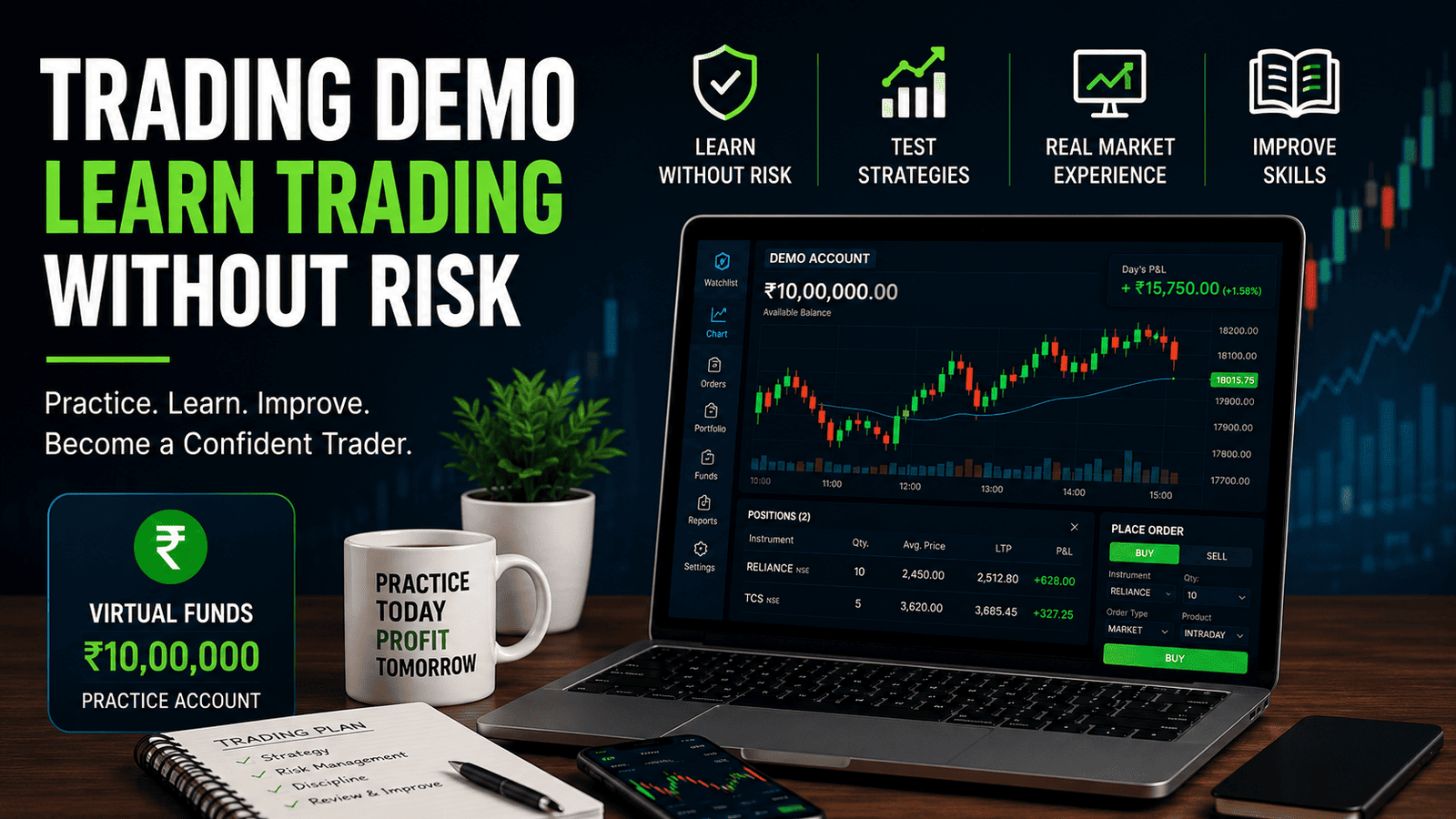
A trading demo, also known as a demo trading account, is a simulated trading environment that allows you to buy and sell financial instruments using virtual money instead of real funds. It is one of the best ways for beginners to learn how financial markets work without taking any financial risk.
Whether you want to trade stocks, futures, options, forex, commodities, or cryptocurrencies, a trading demo lets you practice in real market conditions while protecting your capital. Most brokers provide demo accounts with virtual balances ranging from ₹1 lakh to ₹10 lakh or more, giving you the freedom to test strategies and understand trading platforms before investing real money.
Demo trading is not only for beginners. Experienced traders also use demo accounts to test new strategies, indicators, and risk management techniques before applying them to live markets.
Unlike live trading, a demo account removes the fear of losing money, allowing you to focus on learning the trading process. You can explore different markets, understand price movements, and gain confidence before entering the real market.
Many professional traders recommend spending time on a demo account before switching to live trading. This helps you develop discipline, improve decision-making, and understand how financial markets react under different conditions.
How Does a Trading Demo Account Work?
A demo trading account mirrors a live trading account but uses virtual funds instead of real money. The prices, charts, and market movements are based on real-time or near real-time market data, allowing traders to experience how actual trading works without financial risk.
After creating a demo account, the broker credits your account with virtual capital. You can use these funds to practice buying and selling different financial instruments while learning how professional trading platforms operate.
With a demo account, you can:
- Buy and sell stocks
- Trade futures and options
- Practice forex trading
- Explore commodity markets
- Trade cryptocurrencies
- Use technical indicators
- Place market and limit orders
- Set stop-loss and target orders
- Monitor your profit and loss
- Analyze completed trades
Every trade affects only your virtual balance. If you make a profit, your demo balance increases. If you make a loss, no real money is deducted from your bank account. This allows you to experiment with different strategies and learn from your mistakes without financial consequences.
Most modern trading platforms also provide advanced charting tools, watchlists, technical indicators, and order management features within their demo accounts. Practicing with these tools helps you become comfortable with the platform before trading with real money.
Although demo trading closely resembles live trading, it cannot fully replicate the emotions involved when real money is at risk. Nevertheless, it remains one of the most effective ways to build trading experience, improve confidence, and prepare for live market conditions.
Why Should Beginners Start With Demo Trading?
Many beginners enter the financial markets with the expectation of making quick profits. However, without proper knowledge and practical experience, most new traders struggle with risk management, emotional decision-making, and market volatility. A trading demo account provides a safe environment where beginners can learn essential trading skills before investing real money.
Practicing with virtual funds allows traders to understand how markets move, test different trading strategies, and become familiar with trading platforms. Instead of worrying about financial losses, beginners can focus entirely on learning and improving their trading knowledge.
Learn Without Financial Risk
The biggest advantage of a trading demo account is that it eliminates financial risk. Since every trade uses virtual money, you can experiment with different trading techniques, indicators, and strategies without risking your savings.
This gives beginners the confidence to explore the market, understand price action, and learn from mistakes without any monetary consequences.
Understand Trading Platforms
Modern trading platforms include numerous features that can seem overwhelming at first. A demo account helps you become comfortable using these tools before placing real trades.
With regular practice, you'll learn how to:
- Navigate the trading platform
- Use candlestick charts
- Place market and limit orders
- Set stop-loss and target levels
- Monitor open positions
- Track profit and loss
- Use technical indicators effectively
Practice Risk Management
Successful trading is built on effective risk management rather than simply finding profitable trades. A demo account allows you to practice important risk management techniques before trading with real capital.
You can learn how to:
- Determine proper position sizes
- Set realistic stop-loss levels
- Maintain healthy risk-to-reward ratios
- Manage overall portfolio risk
- Avoid excessive leverage
Developing these habits early helps traders protect their capital when they transition to live trading.
Build Trading Confidence
Confidence comes from preparation and consistent practice. Every completed demo trade improves your understanding of market behavior and strengthens your decision-making skills.
As you gain experience, you'll become more comfortable identifying trade setups, managing positions, and following your trading plan without hesitation.
Key Benefits of Using a Trading Demo Account
1. Learn Trading Without Losing Money
A demo account allows you to experience real market conditions without risking your own capital. Beginners can make mistakes, test new ideas, and improve their skills while using virtual funds.
This practical experience is often more valuable than simply reading books or watching educational videos.
2. Test Different Trading Strategies
Every trader has a unique trading style. Some prefer intraday trading, while others focus on swing trading or long-term investing. A trading demo gives you the flexibility to experiment with multiple strategies before deciding which one matches your personality and goals.
You can compare strategy performance using historical results and identify the methods that consistently produce better outcomes.
3. Practice Technical Analysis
Technical analysis plays a major role in modern trading. A demo account lets you practice reading charts and using popular indicators without financial pressure.
Common tools you can learn include:
- Moving Averages
- Relative Strength Index (RSI)
- MACD
- Bollinger Bands
- VWAP
- Support and Resistance
- Trendlines
- Volume Analysis
Testing these indicators helps you understand which combinations work best for your trading strategy.
4. Improve Decision-Making Skills
Trading requires fast yet disciplined decision-making. Regular practice in a demo account improves your ability to identify opportunities, choose appropriate entry and exit points, and manage open trades effectively.
These skills become increasingly valuable once you begin trading with real money.
5. Gain Real Market Experience
Reading about trading and actually participating in the market are two very different experiences. A demo account gives you valuable screen time, allowing you to observe how markets react to news events, economic data, and changes in investor sentiment.
The more market situations you experience, the more prepared you'll be for live trading.
Demo Trading vs Paper Trading
Although the terms are often used interchangeably, demo trading and paper trading have important differences. Both methods allow traders to practice without risking money, but the overall experience is not the same.
Feature Demo Trading Paper Trading| Uses Virtual Money | Yes | Yes |
| Real-Time Trading Platform | Yes | No (Usually Manual) |
| Order Execution Simulation | Yes | Limited |
| Charting Tools | Included | Depends on the User |
| Best For | Platform Practice & Strategy Testing | Basic Trade Recording |
What Is Paper Trading?
Paper trading is the traditional method of practicing trades by manually recording hypothetical buy and sell decisions in a notebook or spreadsheet. Traders monitor the market and compare their predictions with actual price movements without placing real orders.
While paper trading helps improve market analysis and discipline, it does not provide the experience of using a live trading platform or executing simulated orders.
Why Demo Trading Is Better
A trading demo offers a much more realistic learning experience. It allows traders to practice order placement, use technical indicators, monitor positions in real time, and become familiar with professional trading platforms.
For beginners, a demo account is generally the better choice because it closely replicates the experience of live trading while eliminating financial risk.
Demo Trading vs Live Trading
Many beginners believe that making profits in a demo account guarantees success in live trading. While a trading demo is one of the best learning tools available, it cannot completely replicate the emotions and challenges of trading with real money.
Understanding the differences between demo trading and live trading will help you prepare for the transition and avoid common beginner mistakes.
Feature Demo Trading Live Trading| Money Used | Virtual Money | Real Money |
| Financial Risk | None | High |
| Emotional Pressure | Very Low | Very High |
| Order Execution | Simulated | Real Market |
| Slippage | Rare | Possible |
| Best For | Learning & Practice | Real Investing |
Emotional Control Is the Biggest Difference
Trading with virtual money feels completely different from trading with your own capital. During demo trading, losses don't affect your finances, so most traders remain calm. In live trading, however, emotions such as fear, greed, and anxiety can influence every decision.
Many traders who perform well in a demo account struggle when they switch to live trading because they begin making emotional decisions instead of following their trading plan.
Learning to control emotions is one of the most important skills every trader must develop.
Common Mistakes Demo Traders Make
Although demo trading is designed for learning, many beginners unknowingly develop habits that can hurt their performance once they begin trading with real money.
1. Taking Random Trades
Because there is no financial risk, many beginners enter trades without following any strategy or trading plan. This prevents them from understanding whether a strategy actually works.
Every demo trade should include:
- A clear reason for entry
- A predefined stop-loss
- A realistic profit target
- A planned risk-to-reward ratio
2. Using Unrealistic Capital
Most demo accounts provide virtual balances of ₹10 lakh or more. While this may seem helpful, it often encourages traders to take oversized positions.
If you plan to start live trading with ₹50,000, practice using approximately the same amount in your demo account. This develops realistic position sizing and better risk management habits.
3. Ignoring Stop-Loss Orders
Some traders avoid placing stop-loss orders because they know the money isn't real. This creates dangerous habits that can become expensive during live trading.
Always use a stop-loss and manage risk exactly as you would with a real trading account.
4. Changing Strategies Too Often
Switching strategies after only a few losing trades is a common mistake.
Every trading strategy experiences winning and losing periods. Instead of changing your approach frequently, test one strategy over at least 50 to 100 trades before evaluating its performance.
5. Ignoring Trade Reviews
Many beginners only look at profits and losses without reviewing why a trade succeeded or failed.
After every trade, ask yourself:
- Did I follow my trading plan?
- Was my entry correct?
- Was the stop-loss appropriate?
- Could I have managed the trade better?
- What did I learn?
Regular trade reviews are one of the fastest ways to improve your trading skills.
Why Every Demo Trader Should Keep a Trading Journal
A trading demo teaches you how to place trades, but a trading journal teaches you how to become a consistently profitable trader.
Without recording your trades, it becomes difficult to identify mistakes, measure progress, or improve your trading strategy.
What Should You Record?
A complete trading journal should include:
- Trade date
- Stock or trading instrument
- Entry price
- Exit price
- Stop-loss
- Target price
- Quantity traded
- Profit or loss
- Risk-to-reward ratio
- Trading strategy used
- Market conditions
- Trade screenshots
- Personal notes and lessons learned
Benefits of Keeping a Trading Journal
- Identify your best-performing strategies.
- Find repeated trading mistakes.
- Improve trading discipline.
- Measure your trading performance.
- Increase long-term consistency.
- Build confidence before live trading.
Professional traders don't rely on memory—they rely on data. Keeping a trading journal provides the information needed to continuously improve your trading performance.
How TradeVek Helps Demo Traders Improve
Tracking your demo trades manually can quickly become difficult, especially as your trading history grows. A dedicated trading journal simplifies this process and provides valuable insights that spreadsheets often cannot.
TradeVek helps demo traders organize, analyze, and review every trade in one place.
With TradeVek, you can:
- Record unlimited demo and live trades.
- Track profit and loss automatically.
- Analyze your win rate.
- Monitor your risk-to-reward ratio.
- Measure maximum drawdown.
- Compare different trading strategies.
- Upload trade screenshots.
- Add notes for every trade.
- Review your trading calendar.
- Monitor long-term trading performance.
Instead of spending hours maintaining spreadsheets, you can focus on improving your trading decisions using detailed analytics and performance reports.
Best Practices for Demo Trading
To get the maximum benefit from your demo account, follow these best practices:
- Treat virtual money exactly like real money.
- Follow a written trading plan.
- Risk only a small percentage of your capital on each trade.
- Practice with a realistic account size.
- Focus on one trading strategy at a time.
- Maintain a detailed trading journal.
- Review your performance every week.
- Prioritize consistency over quick profits.
Developing these habits during demo trading makes the transition to live trading much smoother and increases your chances of long-term success.
Frequently Asked Questions (FAQs)
Is demo trading free?
Yes. Most brokers provide a free trading demo account that allows you to practice trading using virtual money. You can learn how financial markets work, test trading strategies, and become familiar with trading platforms without depositing real funds.
Can I make real money from demo trading?
No. Demo trading uses virtual money, so any profits or losses are simulated. The primary purpose of a trading demo account is to help traders learn, gain experience, and build confidence before trading with real capital.
How long should I practice with a demo trading account?
There is no fixed timeframe. Most traders should continue using a demo account until they can consistently follow their trading plan, manage risk effectively, and complete at least 100 to 200 well-documented trades.
Is demo trading better than paper trading?
Both methods help traders practice without financial risk, but demo trading offers a more realistic experience. It includes live market data, simulated order execution, technical analysis tools, and professional trading platforms, making it a better learning environment for most beginners.
Why should I keep a trading journal during demo trading?
A trading journal allows you to record every trade, review mistakes, evaluate strategies, measure performance, and improve discipline. Tracking demo trades helps build good habits before transitioning to live trading.
When should I switch from demo trading to live trading?
You should move to a live trading account only after demonstrating consistent performance in your demo account. Once you can follow your trading plan, manage risk effectively, and maintain discipline over an extended period, you can begin trading with a small amount of real capital.
Conclusion
A trading demo is one of the safest and most effective ways to begin your trading journey. It allows you to understand financial markets, learn how trading platforms work, test strategies, and develop essential risk management skills without risking your own money.
While demo trading provides valuable practical experience, long-term success depends on consistency, discipline, and continuous improvement. Every trade should be reviewed, every mistake should become a lesson, and every strategy should be evaluated using real performance data.
Keeping a detailed trading journal alongside your demo account helps you identify strengths, eliminate weaknesses, and prepare for the emotional challenges of live trading. The more seriously you treat your demo trading experience, the more confident and prepared you'll be when you eventually trade with real capital.
If you're committed to becoming a disciplined trader, start with a demo account, practice consistently, review your performance regularly, and use a structured trading journal to track your progress and make data-driven improvements.