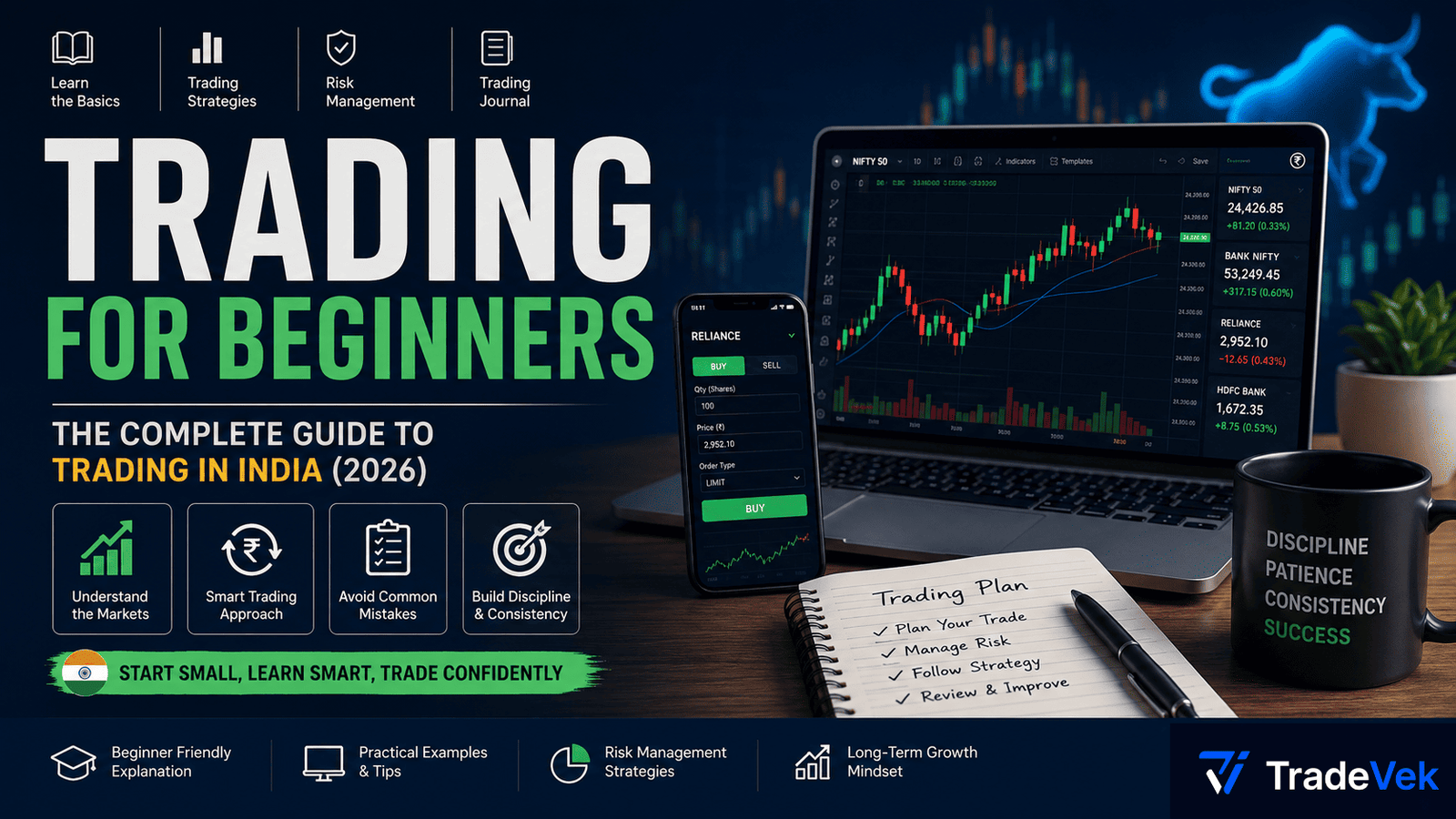
Trading has become one of the most popular ways to participate in India's financial markets. With online brokers, low brokerage charges, and user-friendly trading platforms, anyone can begin their trading journey. However, successful trading requires knowledge, discipline, proper risk management, and continuous learning.
This beginner's guide explains what trading is, how it works, the different markets you can trade in, and the most common trading styles available in India.
What Is Trading?
Trading is the process of buying and selling financial assets such as stocks, commodities, currencies, or derivatives with the goal of earning a profit from price movements. Unlike long-term investing, trading focuses on taking advantage of short-term or medium-term market opportunities.
In India, trading has become increasingly popular thanks to easy-to-use online trading platforms, affordable brokerage charges, and access to educational resources. Anyone with a smartphone, a bank account, and a trading account can participate in the financial markets.
However, trading is not a guaranteed way to make money. Successful traders rely on knowledge, discipline, risk management, and continuous learning rather than luck or tips from social media.
Why Do People Trade?
People choose trading for different reasons depending on their financial goals and lifestyle. Some want an additional source of income, while others aim to build long-term financial independence or pursue trading as a full-time career.
- Generate additional income.
- Grow wealth over time.
- Benefit from short-term market movements.
- Build financial independence.
- Develop a professional trading career.
While these goals are achievable, they require patience and consistent effort. Most beginners lose money because they enter the market without a trading plan or proper education.
Financial Markets You Can Trade
Indian traders can participate in several financial markets. Each market has its own characteristics, risks, and opportunities. Understanding these markets helps you choose the one that best matches your goals and risk tolerance.
| Market | Description | Suitable for Beginners |
|---|---|---|
| Stock Market | Buy and sell shares of listed companies. | Yes |
| Futures & Options | Trade contracts based on underlying assets. | After learning the basics |
| Commodity Market | Trade gold, silver, crude oil, and agricultural products. | Intermediate |
| Forex Market | Trade currency pairs through permitted instruments in India. | Intermediate |
| ETFs | Exchange-traded funds that track an index or asset. | Yes |
Understanding these financial markets allows you to choose the one that aligns with your trading objectives, experience level, and risk tolerance. Many beginners start with stocks or ETFs before moving on to more advanced markets such as futures, options, commodities, or forex.
How Does Trading Work?
Trading works by buying an asset at one price and selling it at another. If the selling price is higher than the buying price, you earn a profit. If the selling price is lower than the buying price, you incur a loss.
Every trade involves a buyer and a seller. Prices continuously change based on supply and demand, company performance, economic conditions, global events, and overall market sentiment.
Example of a Trade
The following example shows how a simple stock trade generates a profit before brokerage charges and taxes.
| Action | Price |
|---|---|
| Buy 100 Shares | ₹500 |
| Sell 100 Shares | ₹540 |
| Profit per Share | ₹40 |
| Total Profit | ₹4,000 (Before Charges & Taxes) |
Similarly, if the market price falls after purchasing the shares, you may incur a loss. This is why proper risk management is essential for every trade.
Key Participants in the Market
Stock prices move because thousands of buyers and sellers place orders throughout the trading day. These participants influence market liquidity and price movements.
The major participants in financial markets include:
- Retail Traders
- Institutional Investors
- Mutual Funds
- Foreign Institutional Investors (FIIs)
- Banks
- Market Makers
Prices change because these participants react to earnings reports, economic data, interest rate decisions, government policies, global events, and investor sentiment.
Basic Trading Process
Every trader follows a series of steps before entering and exiting a trade. Having a structured process helps reduce emotional decisions and improves consistency.
- Open a Trading and Demat Account with a SEBI-registered broker.
- Transfer funds to your trading account.
- Research stocks or other financial instruments.
- Decide your entry price.
- Place a buy or sell order.
- Monitor your trade.
- Exit the trade according to your trading plan.
- Review the outcome and learn from the trade.
Beginners often focus only on buying and selling, but reviewing completed trades is equally important. Maintaining a trading journal helps identify recurring mistakes, improve discipline, and refine your decision-making over time.
Factors That Influence Market Prices
Financial markets react to numerous economic and business events every day. Understanding these factors helps traders make informed decisions instead of relying on rumors or emotions.
Some of the most important market-moving factors include:
- Company Earnings
- Economic Data
- Inflation
- Interest Rate Decisions
- Government Policies
- Global Market Trends
- Corporate Announcements
- Investor Sentiment
Learning how these factors affect prices allows traders to better understand market behavior and make more informed trading decisions.
Types of Trading
There is no single trading style that suits everyone. Your available time, risk tolerance, experience, and financial goals determine which approach is best. Understanding the different trading styles helps you choose the one that matches your personality and objectives.
Intraday Trading
Intraday trading involves opening and closing positions within the same trading day. Traders attempt to capture small price movements and do not carry positions overnight.
Advantages
- No overnight market risk.
- Multiple trading opportunities each day.
- Lower capital requirements for some strategies.
Challenges
- Requires constant market monitoring.
- Emotionally demanding.
- Higher transaction costs if overtrading.
This trading style is suitable for traders who can dedicate several hours during market hours to analyzing charts and managing trades.
Swing Trading
Swing trading involves holding positions for several days or weeks to capture medium-term price movements.
Many beginners prefer swing trading because it provides enough time to analyze charts and make decisions without constantly watching the market.
Advantages
- Less stressful than intraday trading.
- More time for market analysis.
- Easier to combine with a full-time job.
Challenges
- Overnight and weekend market risk.
- Requires patience and discipline.
Positional Trading
Positional trading involves holding trades for several weeks or months while following broader market trends. This style combines technical and fundamental analysis to identify long-term opportunities.
Positional trading is well suited for:
- Working professionals.
- Long-term wealth builders.
- Traders with limited daily screen time.
Options Trading
Options trading involves contracts that provide the right—but not the obligation—to buy or sell an underlying asset at a predetermined price before expiry.
Options are powerful financial instruments but involve greater complexity than buying stocks directly. Beginners should first understand the following concepts:
- Call Options
- Put Options
- Strike Price
- Expiry Date
- Premium
- Time Decay
Learning these concepts thoroughly before trading options can help reduce avoidable mistakes and improve risk management.
Commodity Trading
Commodity trading allows participants to trade products such as precious metals, energy products, and agricultural commodities.
Commonly traded commodities include:
- Gold
- Silver
- Crude Oil
- Natural Gas
- Agricultural Commodities
Commodity prices are influenced by global demand and supply, geopolitical developments, currency fluctuations, and seasonal factors.
Forex Trading
Forex trading involves buying one currency while simultaneously selling another. Indian traders can participate in currency trading through permitted exchange-traded currency derivatives.
Popular currency pairs include:
- USD/INR
- EUR/INR
- GBP/INR
- JPY/INR
Before trading currencies, beginners should understand the applicable regulations and risks associated with the forex market.
Trading vs Investing
Many beginners confuse trading with investing, but they serve different financial objectives. Understanding the differences helps you choose the approach that best matches your goals.
| Feature | Trading | Investing |
|---|---|---|
| Objective | Profit from price movements | Long-term wealth creation |
| Holding Period | Minutes to months | Years |
| Analysis | Mostly technical (often combined with fundamentals) | Mostly fundamental |
| Risk Level | Higher | Moderate |
| Frequency | High | Low |
| Time Commitment | High | Lower |
Which Is Better?
Neither trading nor investing is universally better. The right choice depends on your financial goals, available time, risk tolerance, and personal preferences.
Choose Trading If You:
- Enjoy analyzing charts.
- Can follow a disciplined trading plan.
- Are comfortable with short-term market fluctuations.
Choose Investing If You:
- Want long-term wealth creation.
- Prefer holding quality companies over time.
- Have limited time to monitor the markets.
Many successful market participants combine both approaches by investing for long-term wealth creation while allocating a smaller portion of their capital to active trading.
Regardless of the strategy you choose, continuous learning, disciplined execution, effective risk management, and regularly reviewing your trades are essential for long-term success in the financial markets.
How to Start Trading in India
Starting your trading journey in India is easier than ever, but long-term success depends on preparation rather than rushing into your first trade. Building a strong foundation with the right knowledge, tools, and discipline can help you avoid common beginner mistakes.
Follow these essential steps before placing your first trade.
1. Learn the Basics
Before investing your money, understand the fundamentals of trading. A strong understanding of market concepts will help you make informed decisions instead of relying on tips or emotions.
Focus on learning the following topics:
- Stock market basics
- Market Orders and Limit Orders
- Candlestick Charts
- Support and Resistance
- Trend Analysis
- Risk Management
- Trading Psychology
Free educational resources, books, and reputable financial websites are excellent places to begin your learning journey.
2. Choose a SEBI-Registered Broker
A stockbroker provides access to the stock market. Before opening an account, compare different brokers based on important features that affect your trading experience.
| Feature | Why It Matters |
|---|---|
| Brokerage Charges | Lower trading costs can improve profitability. |
| Trading Platform | A fast and reliable platform ensures smooth order execution. |
| Customer Support | Helpful when facing technical or account-related issues. |
| Research Tools | Useful for analyzing stocks and market trends. |
| Mobile App | Allows you to trade and monitor positions from anywhere. |
Always verify that your broker is registered with SEBI before opening a trading account.
3. Open a Demat and Trading Account
To trade in the Indian stock market, you will typically need the following documents:
- PAN Card
- Aadhaar Card
- Bank Account
- Mobile Number
- Email Address
- Passport-size Photograph (if required)
Most brokers now offer completely online account opening with paperless KYC verification.
4. Add Funds
Transfer only the amount you can comfortably afford to lose. Avoid borrowing money or using emergency savings for trading, as financial pressure often leads to poor trading decisions.
5. Create a Trading Plan
Every successful trader follows a written trading plan. A well-defined plan helps maintain discipline and reduces emotional decision-making during volatile market conditions.
Your trading plan should include:
- Markets you will trade
- Entry conditions
- Exit strategy
- Maximum daily risk
- Position size
- Profit target
- Stop-loss rules
6. Start Small
Many beginners make the mistake of investing too much money in their first few trades. Instead, begin with smaller position sizes and focus on building consistency.
- Start with small position sizes.
- Focus on learning before earning.
- Increase your capital only after achieving consistent results.
7. Review Every Trade
Reviewing completed trades is one of the fastest ways to improve your trading performance. Keeping a trading journal allows you to identify strengths, weaknesses, and recurring mistakes.
After every trade, ask yourself:
- Why did I enter this trade?
- Did I follow my trading plan?
- Was my risk management effective?
- What could I improve next time?
Consistently reviewing your trades helps you become a more disciplined and confident trader over time.
Best Trading Platforms for Beginners
Choosing the right trading platform can make your learning experience smoother. A beginner-friendly platform should be easy to navigate, reliable, and provide essential charting and order management features.
When comparing trading platforms, consider the following features before opening your account.
| Feature | Importance |
|---|---|
| Easy-to-use Interface | Helps beginners trade confidently. |
| Fast Order Execution | Reduces execution delays. |
| Advanced Charts | Supports technical analysis. |
| Mobile Accessibility | Monitor trades from anywhere. |
| Low Brokerage | Keeps trading costs lower. |
| Educational Resources | Helps you learn faster. |
What Should Beginners Look For?
A good trading platform should provide all the essential tools required for learning and managing trades efficiently.
- Real-time market data
- Multiple order types
- Portfolio tracking
- Watchlists
- Technical indicators
- Price alerts
- Secure login and transactions
Instead of choosing a platform solely based on low brokerage charges, evaluate its reliability, stability, user experience, and customer support.
Trading Demo Accounts
One of the smartest ways to begin trading is by using a demo account or paper trading environment before risking real money.
A demo account allows you to practice trading using virtual money while experiencing real market movements. This helps you understand how trading works, test strategies, and build confidence without risking your capital.
Benefits of Demo Trading
- Learn how trading orders are placed.
- Understand chart patterns.
- Practice technical analysis.
- Build trading confidence.
- Test different trading strategies.
- Improve discipline before trading with real money.
What You Can Learn from Demo Trading
During your practice sessions, focus on developing the habits that will be essential when trading with real capital.
- Entry timing
- Stop-loss placement
- Profit targets
- Position sizing
- Trade management
Avoid treating demo trading like a game. Follow the same discipline, risk management, and trading plan that you would use with real money.
Common Mistakes in Demo Trading
Many beginners fail to get the full benefit of demo trading because they develop unrealistic habits.
- Taking unnecessary risks because the money isn't real.
- Ignoring stop-losses.
- Entering random trades without analysis.
- Overtrading.
Using realistic position sizes and following a structured trading plan makes demo practice far more valuable.
Risk Management for Beginners
Risk management is often the difference between traders who survive in the market and those who quit after a series of losses.
Even the best trading strategy cannot guarantee winning every trade. That's why controlling losses is more important than chasing profits.
Why Risk Management Matters
Imagine two traders:
- Trader A risks 50% of their capital on one trade.
- Trader B risks only 1% of their capital per trade.
If both traders experience several consecutive losing trades, Trader B has a much greater chance of staying in the market and recovering over time. Protecting your capital should always be the first priority.
Risk Management Rules Every Beginner Should Follow
Never Risk More Than You Can Afford to Lose
Trade only with money specifically allocated for investing. Never use funds needed for rent, bills, education, or other essential expenses.
Always Use a Stop-Loss
A stop-loss automatically limits potential losses if the market moves against your position.
Benefits of using a stop-loss include:
- Protecting your trading capital.
- Removing emotional decision-making.
- Preventing large unexpected losses.
Every trade should have a predefined exit point before it is entered.
Follow Proper Position Sizing
Never invest your entire trading capital in a single position. Instead, determine your position size based on:
- Total trading capital.
- Maximum acceptable risk per trade.
- Stop-loss distance.
Proper position sizing helps maintain consistency even during periods of consecutive losses.
Avoid Overtrading
Many beginners believe placing more trades leads to higher profits. In reality, excessive trading often reduces profitability.
Overtrading can result in:
- Higher brokerage costs.
- Emotional fatigue.
- Poor-quality trade selection.
Focus on taking high-probability trading setups instead of trading frequently.
Diversify When Appropriate
Avoid concentrating all your capital in a single stock or sector. Diversification can reduce the impact of adverse price movements in any one investment.
Manage Your Emotions
Fear and greed are among the biggest psychological challenges in trading. Successful traders remain disciplined regardless of recent wins or losses and follow their trading plan instead of making impulsive decisions.
One practical way to improve discipline is by maintaining a trading journal. Record every trade, including the reason for entry, exit, emotions experienced, and lessons learned. Over time, these records help identify recurring mistakes, improve decision-making, and build long-term consistency.
Common Trading Mistakes
Every successful trader has made mistakes. The difference is that they learn from them instead of repeating them. If you're just starting, avoiding these common errors can save you both money and frustration.
1. Trading Without a Plan
Entering a trade without knowing your entry price, target, and stop-loss is one of the biggest mistakes beginners make. A written trading plan helps you make objective decisions instead of emotional ones.
2. Ignoring Risk Management
Many new traders focus only on potential profits while ignoring potential losses. Never risk a large percentage of your capital on a single trade. Protecting your capital should always be your first priority.
3. Overtrading
Placing too many trades often leads to unnecessary losses and higher brokerage costs. Quality is more important than quantity. Wait patiently for trading setups that match your strategy instead of forcing trades.
4. Following Tips Blindly
Social media, messaging groups, and online forums are filled with stock tips. While some may occasionally work, relying on them without doing your own research is risky. Learn to analyze charts and understand the reasons behind every trade before investing your money.
5. Letting Emotions Control Decisions
Fear, greed, and impatience are among the biggest reasons traders make poor decisions.
Common emotional mistakes include:
- Exiting profitable trades too early.
- Holding losing trades for too long.
- Entering trades without confirmation.
- Revenge trading after a loss.
Following your trading plan consistently helps reduce emotional decision-making and improves long-term consistency.
6. Not Reviewing Trades
Every completed trade provides valuable lessons. Reviewing your trades regularly helps you understand what worked, what didn't, and where you can improve. Consistent review is one of the fastest ways to become a better trader.
Best Books to Learn Trading
Reading books written by experienced traders can significantly shorten your learning curve. These books cover trading psychology, technical analysis, discipline, and successful trading strategies.
| Book | Why Read It |
|---|---|
| Trading in the Zone — Mark Douglas | Develops trading discipline and mindset. |
| The Disciplined Trader — Mark Douglas | Explains the psychology behind successful trading. |
| How to Make Money in Stocks — William J. O'Neil | Covers growth investing and stock selection. |
| Japanese Candlestick Charting Techniques — Steve Nison | A classic guide to candlestick patterns. |
| Market Wizards — Jack D. Schwager | Interviews with successful traders and their strategies. |
While books provide valuable knowledge, real improvement comes from applying what you learn through practice, market analysis, and continuous review.
Why Every Trader Should Keep a Trading Journal
Many beginners believe that finding the "perfect strategy" is the key to success. In reality, long-term improvement comes from understanding your own trading behavior.
A trading journal is one of the most effective tools for achieving consistent growth as a trader.
What Is a Trading Journal?
A trading journal is a record of every trade you take. Recording detailed information allows you to evaluate your decisions objectively and improve over time.
A trading journal typically includes:
- Entry price
- Exit price
- Stop-loss
- Profit or loss
- Position size
- Strategy used
- Market conditions
- Chart screenshots
- Emotions before and after the trade
- Lessons learned
Over time, this information helps identify strengths, weaknesses, and recurring trading patterns.
Benefits of Maintaining a Trading Journal
A well-maintained trading journal helps you:
- Identify profitable trading strategies.
- Eliminate repeated mistakes.
- Improve trading discipline.
- Measure trading performance.
- Build confidence using real trading data.
- Stay accountable to your trading plan.
Without a journal, it's difficult to know whether you're genuinely improving or simply relying on memory.
Using TradeVek as Your Trading Journal
If you're looking for an organized way to track your trades, TradeVek provides an online trading journal designed specifically for traders.
With a digital trading journal, you can:
- Record every trade in one place.
- Monitor profit and loss.
- Review your complete trading history.
- Analyze performance over time.
- Identify recurring mistakes.
- Build better trading habits through consistent review.
Whether you're a beginner or an experienced trader, maintaining a trading journal can help you make more informed decisions and continuously refine your trading process.
Frequently Asked Questions
Is trading legal in India?
Yes. Trading in stocks and other permitted financial instruments through SEBI-registered brokers is legal in India. Always ensure you understand the regulations and products you are trading.
How much money do I need to start trading?
There is no fixed minimum amount. Many beginners start with a small amount while learning. Proper risk management is far more important than the size of your trading capital.
Which type of trading is best for beginners?
Swing trading is often considered suitable for beginners because it provides more time for analysis and decision-making than intraday trading. However, the best trading style depends on your goals, schedule, and risk tolerance.
Should I start with a demo account?
Yes. Demo or paper trading allows you to understand market mechanics, practice trading strategies, and build confidence before risking real money.
Can I learn trading from books alone?
Books provide an excellent foundation, but practical experience is equally important. Combine reading with chart analysis, demo trading, and regular trade reviews for the best results.
Is trading better than investing?
Neither is universally better. Trading focuses on short- to medium-term opportunities, while investing aims for long-term wealth creation. Your financial goals and risk tolerance should determine your approach.
What is the biggest mistake beginners make?
The most common mistakes include trading without a plan, risking too much capital, ignoring stop-losses, following tips blindly, overtrading, and failing to review past trades.
Why should I maintain a trading journal?
A trading journal helps you track performance, identify mistakes, measure progress, improve discipline, and turn every trade into a valuable learning experience.
Final Thoughts
Trading offers exciting opportunities, but long-term success doesn't come from luck or chasing quick profits. It comes from building a strong foundation, following a disciplined trading plan, managing risk carefully, and continuously learning from your experience.
As a beginner, focus on developing good trading habits instead of trying to make money immediately.
- Learn the fundamentals before placing your first trade.
- Choose a reliable trading platform.
- Practice with demo trading whenever possible.
- Protect your capital through proper risk management.
- Avoid emotional trading decisions.
- Review every trade regularly.
- Keep improving through education and practical experience.
Remember that even experienced traders have losing trades. What separates successful traders is their ability to manage risk, remain disciplined, and continuously adapt to changing market conditions.
If you want to become a consistently better trader, start tracking every trade from day one. A well-maintained trading journal can reveal patterns that charts alone cannot, helping you make smarter decisions and improve with confidence.
Trading is a journey, not a race. Stay patient, keep learning, follow your plan, and focus on consistent improvement rather than chasing quick profits.