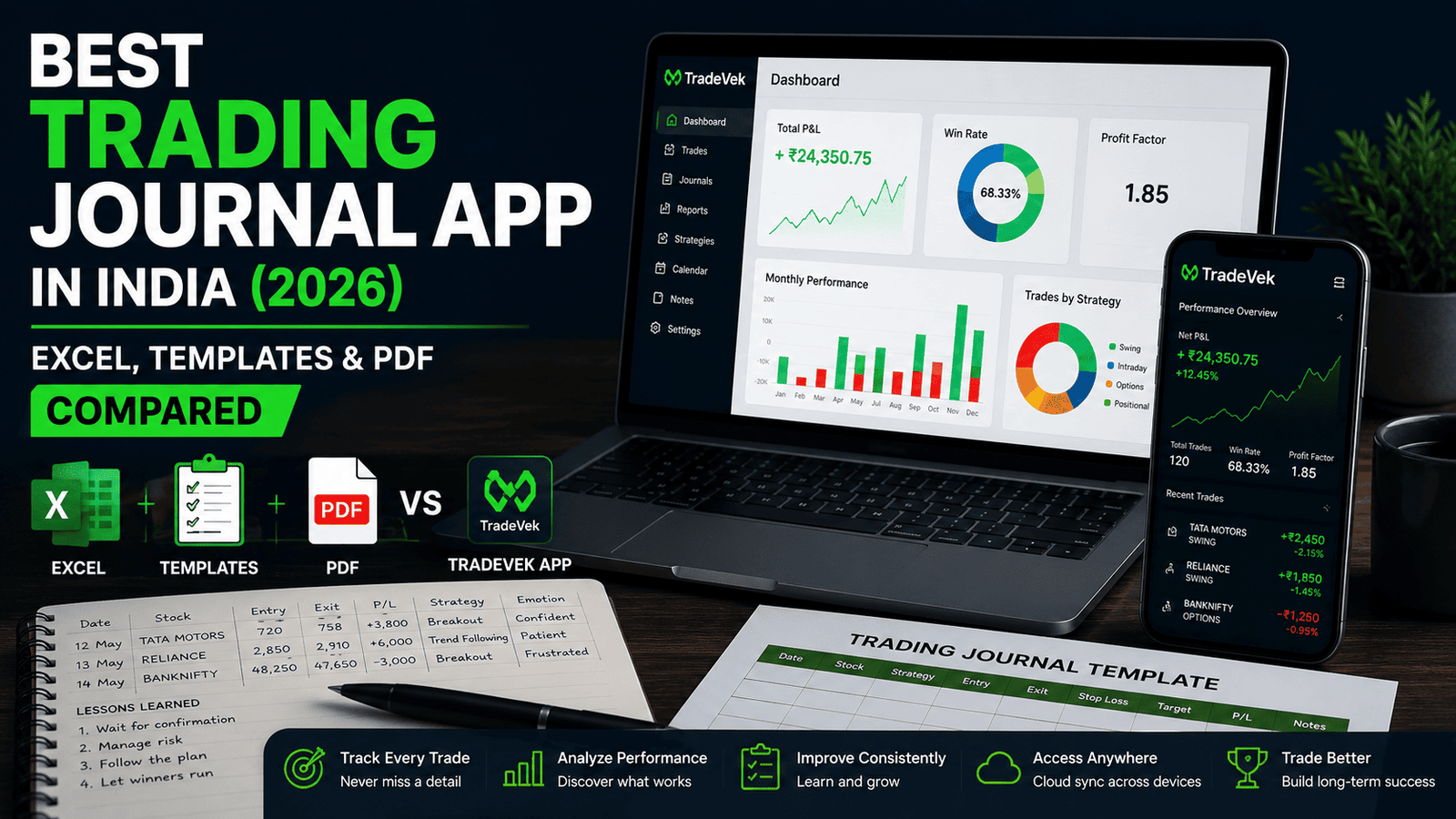
Best Trading Journal App in India (2026): Excel, Templates & PDF Compared
Every successful trader has one habit in common—they review their trades consistently. Whether you trade stocks, options, futures, or commodities, keeping a trading journal is one of the fastest ways to improve your performance.
Many traders spend hours searching for the perfect trade journal Excel sheet, a printable trading journal template, or even a trading journal book PDF. While these tools are useful, they often become difficult to maintain as your trading activity grows.
This is where a dedicated trading journal app like TradeVek can make a real difference. It simplifies trade tracking, performance analysis, and mistake identification—all in one place.
In this guide, we'll compare Excel journals, templates, PDFs, and online trading journal apps to help you choose the best option for your trading journey.
What Is a Trading Journal?
A trading journal is a record of every trade you take. It goes beyond recording profits and losses by capturing the reasons behind each trade, your emotions, risk management decisions, and lessons learned.
A good trading journal typically includes:
| Information | Example |
|---|---|
| Stock Name | Reliance Industries |
| Trade Type | Swing Trade |
| Buy Price | ₹2,850 |
| Sell Price | ₹2,940 |
| Quantity | 100 Shares |
| Profit/Loss | ₹9,000 |
| Entry Reason | Breakout above resistance |
| Exit Reason | Target achieved |
| Emotion | Confident |
| Lesson Learned | Hold winners longer |
Over time, this information helps identify patterns and improve decision-making.
Why Every Trader Needs a Trading Journal
Most traders believe success depends only on finding good stock picks. In reality, consistent profitability comes from reviewing past trades and learning from mistakes.
A trading journal helps you:
- Identify profitable trading setups
- Eliminate emotional trading
- Improve discipline
- Track win rate
- Measure risk-reward ratio
- Monitor overall performance
- Build confidence through data
Professional traders don't rely on memory—they rely on documented performance.
Different Types of Trading Journals
1. Trade Journal Excel
Excel remains one of the most popular choices for beginners because it is free and customizable.
Advantages
- Free to use
- Fully customizable
- Easy calculations
- Offline access
Disadvantages
- Manual data entry
- Time-consuming
- Difficult to analyze performance
- No automatic reports
- Higher chance of mistakes
Excel works well initially but becomes harder to manage once you have hundreds of trades.
2. Trading Journal Template
A trading journal template provides a ready-made structure where traders simply enter trade details.
Most templates include:
- Entry Price
- Exit Price
- Quantity
- Stop Loss
- Target
- Risk
- Reward
- Profit
- Notes
Templates save time compared to creating your own spreadsheet from scratch. However, they still require manual updates and calculations.
3. Trading Journal Book PDF
Some traders prefer writing trades in a printed journal or PDF workbook.
Benefits
- No screen distractions
- Helps develop discipline
- Easy daily review
Drawbacks
- Difficult to search old trades
- No analytics
- Cannot generate reports
- Time-consuming
Paper journals work well for habit building but are limited for long-term analysis.
4. Trading Journal App
A trading journal app automates most of the manual work.
Instead of maintaining multiple Excel sheets, everything stays organized in one dashboard.
Features usually include:
- Trade tracking
- Performance reports
- Win rate calculation
- Strategy analysis
- Risk management tracking
- Charts
- Trade screenshots
- Notes
- Cloud storage
Apps save significant time while providing deeper insights than spreadsheets.
Trading Journal Format
A well-designed journal should record much more than entry and exit prices.
| Field | Description |
|---|---|
| Date | Trade Date |
| Stock | Company Name |
| Segment | Equity, Options, Futures |
| Strategy | Breakout, Pullback, Trend Following |
| Entry Price | Buy Price |
| Exit Price | Sell Price |
| Stop Loss | Risk Level |
| Target | Planned Exit |
| Quantity | Position Size |
| Risk Reward | Example 1:2 |
| Profit/Loss | Final Result |
| Emotion | Fear, Confidence, Greed |
| Mistakes | Early Exit, Late Entry |
| Lessons | What to Improve |
Recording emotional factors is just as important as recording financial results.
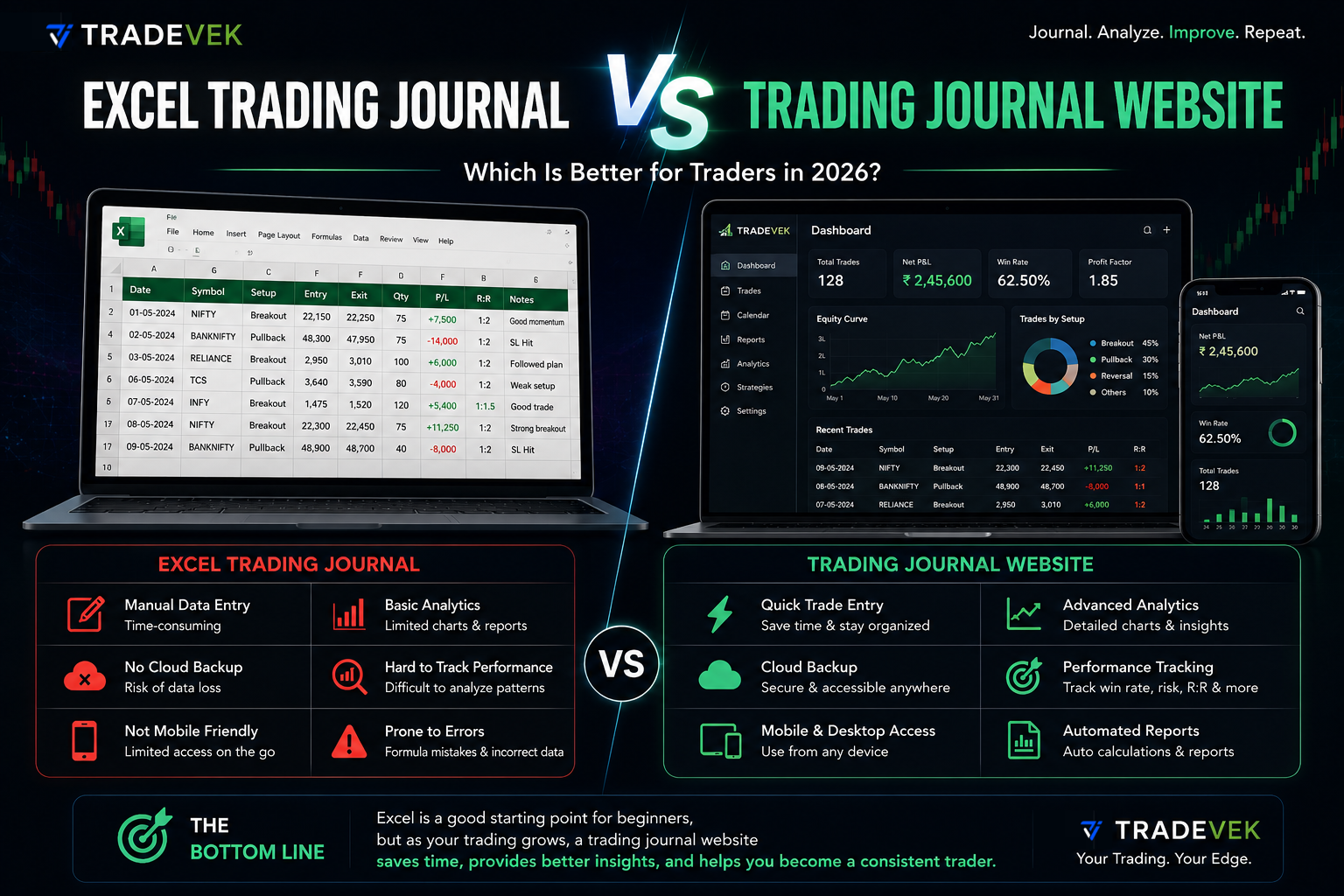
Excel vs Trading Journal App
| Feature | Excel | Trading Journal App |
|---|---|---|
| Automatic Reports | ❌ | ✅ |
| Performance Dashboard | ❌ | ✅ |
| Charts | Limited | ✅ |
| Mobile Access | Limited | ✅ |
| Cloud Backup | ❌ | ✅ |
| Strategy Analysis | Manual | Automatic |
| Ease of Use | Medium | Easy |
For traders taking multiple trades every week, an app offers a much smoother experience.
Example: Zerodha Swing Trader
Imagine Rahul, a swing trader using Zerodha.
- Stock: Tata Motors
- Entry: ₹720
- Stop Loss: ₹700
- Target: ₹760
- Quantity: 100
After exiting at ₹758, he records:
- Strategy: Breakout
- Emotion: Patient
- Risk Reward: 1:2
- Lesson: Waited for confirmation before entering.
After recording 100 similar trades, Rahul notices that breakout trades have an 82% success rate, while reversal trades only achieve 48%. Without a journal, identifying this pattern would be extremely difficult.
Common Mistakes Traders Make
Recording Only Profits
Many traders ignore losing trades. Losses often provide the most valuable lessons.
Ignoring Emotions
Fear and greed influence trading decisions. Recording emotional states helps identify behavioral patterns.
Not Reviewing Trades
A journal is useful only if you review it regularly. Schedule weekly and monthly reviews.
Inconsistent Entries
Skipping trades creates incomplete data. Record every trade regardless of the outcome.
Chasing New Strategies
Many traders switch strategies after a few losses. A journal provides enough historical data to determine whether a strategy genuinely works.
Expert Tips for Better Journaling
- Record trades immediately after execution.
- Add chart screenshots before and after each trade.
- Rate every trade out of 10 based on execution quality.
- Review your journal every week.
- Focus on following your trading process rather than only profits.
Why Indian Traders Need a Trading Journal
Indian markets are fast-moving and influenced by earnings, global events, and sector-specific news.
Whether you trade through Zerodha, Upstox, Groww, Angel One, or another broker, maintaining a journal helps you:
- Improve discipline
- Reduce emotional decisions
- Track strategy performance
- Manage risk effectively
- Build confidence through data
A journal becomes your personal trading coach, showing what works and what needs improvement.
Why TradeVek Is Better Than Excel
While Excel sheets and PDF journals are useful for beginners, they become difficult to maintain as trading activity increases.
- Easy trade recording
- Performance dashboard
- Win rate analysis
- Risk management insights
- Trade screenshots
- Strategy tracking
- Cloud access
- Clean reports
- Mobile-friendly interface
- Faster trade reviews
Instead of spending hours updating spreadsheets, you can focus on improving your trading.
Frequently Asked Questions
Is Excel enough for a trading journal?
Yes, beginners can start with Excel. However, active traders usually benefit from a dedicated trading journal app with automated analytics.
What should every trading journal include?
Date, stock, entry, exit, quantity, strategy, stop loss, target, profit/loss, emotions, and lessons learned.
How often should I review my journal?
Weekly reviews help identify short-term mistakes, while monthly reviews reveal long-term performance trends.
Can a trading journal improve profitability?
A journal cannot guarantee profits, but it helps traders identify patterns, refine strategies, and avoid repeating mistakes.
Is TradeVek suitable for beginners?
Yes. TradeVek is designed for beginners as well as experienced swing, options, and intraday traders.
Final Thoughts
Keeping a trading journal is one of the simplest yet most powerful habits a trader can develop. Whether you begin with an Excel spreadsheet, a printable template, or a PDF journal, the key is to consistently record, review, and learn from every trade.
As your experience grows, moving to a dedicated trading journal app can save time and provide valuable insights that spreadsheets cannot. By analyzing your strategies, emotions, and risk management over hundreds of trades, you'll make more informed decisions and build the discipline needed for long-term success.